Showing posts with label prison. Show all posts

Sunday, March 30, 2008

3/30/08- 100 Years Ago... Today


"Monday Morning.

Went to bed at 12:30 and was asleep in a few minutes. Slept soundly until called at 3:45. Feel refreshed and calm. I am surprised that I can look at this matter so calmly. Had communion for the first time. I feel that I am fully prepared to go and meet Jesus. I shall watch for the others.

Was so glad when "Mac" told me that Paul had taken a stand for Christ. This makes me happier than anything else could have done. May the rest be comforted as I have been in these last moments.

Had a very nice little breakfast and appreciate everyone's kindness. They have all been so kind and courteous. I am very grateful to each one. Good morning All.

P.S. If it isn't any extra expense or too much trouble please have "Taps" played at the last.

'Gone to be with Jesus.'

Chester."

The following passage contained the last words that were written one hundred years ago today by Chester Ellsworth Gillette. He finished the entry just ten minutes before two guards arrived at his cell on Death Row at Auburn State Prison to lead him to the chamber that held the electric chair where he paid the ultimate price for the murder of Grace Brown nearly two years earlier.

Those words can still be read today in the recently published book, "The Prison Diary and Letters of Chester Gillette" by Craig Brandon and Jack Sherman. The diary book basically told the story of Chester's redemption as he acknowledged the pain he caused his family and friends because of his actions and begged for a chance to repay them for everything that they did for him.

It also describes how Chester was able to accept his fate so calmly, even though he remained blindly confident that some miraculous legal act would come into play and he would be granted a new trial and released. Even when he walked into the chamber and sat down in the chair, he was able to accept his fate with dignity.

Unlike the centennial commemorating Grace's death in 2006, the question here is, how do you commemorate an execution, even if is the execution of a murderer whose actions spawned a classic novel, two movies, and an opera? That's probably one question that is very hard to answer. Hopefully, he may finally have found the peace he was looking for.

Thursday, May 24, 2007

5/24/07- Creating An American Tragedy

By 1923, author Theodore Dreiser was very hard at work on a novel that he hoped would become his crowning achievement. It was novel about a man who was torn between two women from completely different worlds and while in pursuit of the American Dream, he commits an unforgivable act. He was calling the book, based on the real-life murder of Grace Brown by Chester Gillette at Big Moose Lake in 1906, "An American Tragedy."

To prepare for his novel, Dreiser obtained a copy of the trial transcript; went on a road trip to view the sites where the story took place, including the murder scene at Big Moose Lake. He also viewed Grace's love letter, which by then were in the possession of the family of District Attorney George Ward, who died in the Spanish Flu Epidemic of 1918. He also went through some of the old New York City paper articles that dated back to the trial which he had saved.

In order to make the novel fictional, he basically changed whatever he could about the events and the locations of the original case. For starters, he changed the Gillette Skirt Factory into a shirt collar factory and he changed the city and the location from Cortland to an area of Central New York that he named "Lycurgus." On a map, it would be near the real-life factory town of Canajoharie. He also changed the name of all of the key players and places that figured into the Gillette story. For example: Big Moose Lake became known as Big Bittern Lake and it was located near the Canadian border. The town where Chester (or Clyde Griffiths as he is known in the novel) was tried in was changed from Herkimer to Bridgeburg and the county name was changed from Herkimer to Cataraqui County.

Dreiser even changed Chester's background a little bit by stating that Clyde originally hailed from Kansas City and most of the events that happened to Clyde in the first part of the novel were based more on Dreiser's upbringing rather than Chester's. However, Dreiser retained the excessively-religious environment that both Chester and Dreiser were brought up in. He also made Grace (renamed Roberta Alden in the book) into a poor farm girl from a poor, unkempt family farm, a far cry from the real Grace's family who were actually middle-class people and very well thought of. Then he turned Ward (renamed Orville Mason) into the main villain of the story, a district attorney who was a raving lunatic looking to send a man to the electric chair to serve his political ends. Ward, although he was elected Herkimer County Judge a week before Chester's trial started, was not like that.

And yet there were some things that Dreiser retained from the Gillette story. In the novel, he used Grace's letters almost word for word; he used Chester's final statement that was written before his execution in 1908 exactly word for word save for Clyde's signature at the end; he kept Auburn as the prison where Clyde was executed even though by the time the novel was published, state executions were only carried out at Sing Sing Prison in Ossining, NY; and using the city papers as a base, he created a love triangle with a rich girl. At the trial, the press made a big deal out of Chester's relationship with Harriet Benedict, the daughter of a prominent Cortland lawyer, even though the true nature of their relationship was strictly based on being merely friendly acquaintances.

It took Dreiser nearly two years to get his book ready for publication and by the end of 1925, he finally unveiled "An American Tragedy" to the world. It was written in three parts and it was well over 800 pages long, about the length of a Harry Potter book. Still the general public bought the book and it became a major sensation.

In Central New York, the novel's release put Chester and Grace back in the news again, especially in Herkimer County. Just prior to Dreiser's novel, the case had been all but forgotten and seemed on the verge of fading into local legend. After Dreiser's novel was released and even a few years afterward, people began to take Dreiser's word as gospel as to what actually happened at Big Moose Lake in 1906 and it would take years before the real story began to filter back to the surface.

But for now, Dreiser finally had his masterpiece and a famous murder case finally achieved legendary status.

Thursday, March 08, 2007

3/8/07- Chester's Diary


A new chapter in the saga of Chester Gillette and Grace Brown was opened on Tuesday, March 6 with the donation of Chester's diary to Hamilton College's Burke Library by a descendant of Chester's.

The diary was written during the last six and a half months of Chester's life while he was in Auburn Prison awaiting execution by electric chair and ever since after the execution in 1908, the diary was in the possession of the family of Chester's sister, Hazel Gillette McWade (1887-1975)for generations before it was passed down to Hazel's granddaughter, Marlynn McWade-Murray of Tallahassee, Florida. After conducting an Internet search for her great-uncle and realizing the importance of the diary, she got in touch with Craig Brandon, author of "Murder in the Adirondacks" and "Grace Brown's Love Letters." Craig then put her in touch with Randall Ericson, the librarian at Hamilton College and they agreed that the diary should be donated to the library's vast Gillette collection that included District Attorney George Ward's court documents, old newspaper clippings and of course, Grace's love letters.

In the diary, we are introduce to a very different Chester as opposed to the Chester we know from previous historical accounts. The Chester in the diary is more mature, more spiritual and more concerned for his family's future after his death. This was a far cry from the Chester Gillette that was portrayed in the trial transcript, the press, and history.

In short, the diary is the story of Chester's redemption.

As I sat in the audience listening to the presentation and listening to the passages read from the diary, including his last entry that was written just minutes before he was led to the electric chair, I too was surprised by the new interpretation of Chester. It made me step back and reevaluate what I have learned about him during the year and a half that I have been involved with the story of Chester and Grace.

The only things that the diary does not contain is a confession that many expected Chester to write, nor does it offer an account of what happened to Grace at Big Moose Lake on July 11, 1906. However, he does mention Grace only once in a passage where he admitted that he was never in love with her. Other than that, the diary is more about his transition from boy to man as he waited for his death.

I did meet Marlynn before I left the presentation. She is a very nice person and I saw a little bit of her grandmother in her. From what I have learned about her grandmother, who was 19 at the time of the murder in 1906, she was a really strong young woman considering what she had to deal with. And while my heart is still with Grace, Hazel was someone to be admired.

And so was Chester.

Wednesday, August 09, 2006

8/9/06- An Easy Death


Auburn Prison. March 30, 1908. 3:45 am.

Two guards entered the cell block known as "Murderer's Row" and walked to the cell closest to a large metal door containing a room where no prisoner would ever return. Once they arrived, they awoke the prisoner that resided in that cell and handed him a new prison uniform. This uniform was designed with slits in the sleeves and trouser legs to allow the electrode straps to be fastened to the prisoner's wrists and ankles before the prisoner was executed.

Two hours later, the guards came back and announced that it was time for the prisoner to be led to the electric chair. The other cells on Murderer's Row had to close a curtain over each cell to prevent the other inmates from seeing what was going on, but they didn't need to see what was going on, for soon it would be their turn. Then, Chester Gillette stepped out of his cell along with his spiritual adviser, the Reverend Henry MacIllravy of Little Falls and the prison chaplain to begin the final walk to the electric chair.

The witnesses were all gathered in the execution chamber to see Chester pay the ultimate penalty for the murder of his pregnant lover, Grace Brown. Among them was Austin Klock, who by then was Sheriff of Herkimer County. He was there because Chester wanted him to be there to witness his execution. Representing Grace and her family at the execution was Dr. J. Mott Crumb, the South Otselic town doctor and husband of her teacher and best friend. They could hear the two clergymen reciting the 23rd Psalm as the small procession entered the chamber ahead of Chester, who was flanked by the two guards.

As he did at his trial, Chester displayed no emotion as he calmly walked to the chair and sat down. The guards fastened the straps to his wrists and ankles and fastened the metal cap to his head.

At 6:14 am, the warden gave the order to proceed. The execution threw the switch sending 1800 volts of electricity through the wires to the chair. The witnesses then saw Chester lurch suddenly in the chair and his body shuddered continuously for about a minute before the warden gave the order to cut the power. After the power was turned off, Chester slumped back into the chair. The doctors then examined his body to make sure that the execution was successful.

By 6:18 am, it was official. Chester Ellsworth Gillette became the twenty-seventh victim of Auburn's electric chair. He was only 24 years old. He had been in Auburn for fifteen months.

After the execution, Klock made a statement that he was relieved that Chester was finally out of his misery, while Dr. Crumb commented that he had never seen anything as easy as Chester's execution. The prison officials stated that Chester's execution was the most successful execution in the prison's history. MacIllravy gave the press Chester's final statement (which did not contain a confession) and stated that no legal mistake was made in his execution.

After an autopsy was performed in which his brain was removed, Chester's body was returned to his family for burial. The next day, accompanied by his family and MacIllravy, Chester's body was taken to Soule Cemetery, on the outskirts of Auburn and was buried in an unmarked grave. To this day, no one really knows where it is. A couple of days later, Chester's family gathered Chester's final belongings and left New York State only to fade into history.

Grace Brown remained buried in Valley View Cemetery in South Otselic, where she was buried the day after Chester's arrest in Inlet. Unlike Chester, her grave has a headstone which says that she is "at rest."

Or is she?

Saturday, June 17, 2006


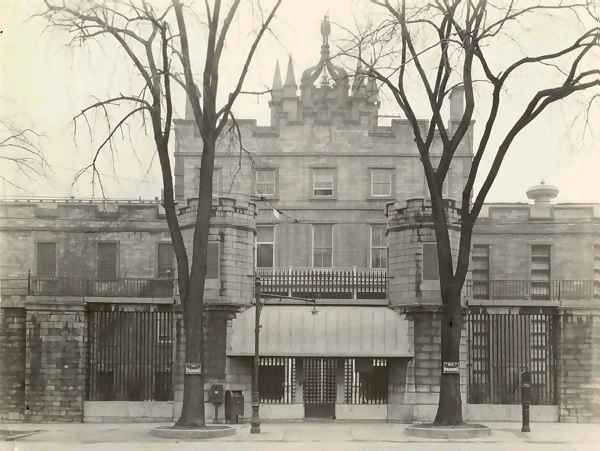
6/17/06- AUBURN


AUBURN. THE MOST FEARED INSTITUTION IN NEW YORK STATE DURING THE VICTORIAN ERA. KNOWN FOR THE "AUBURN SYSTEM" (ABSOLUTE SILENCE), STRIPED UNIFORMS, AND THE LOCKSTEP, IT GAINED ITS BRUTAL REPUTATION AND THEREFORE MADE A POPULAR TARGET OF REFORMERS. ON AUGUST 1, 1890, AUBURN BECAME KNOWN AS "THE BIRTHPLACE OF THE ELECTRIC CHAIR" AS A CONDEMNED MURDERER NAMED WILLIAM KEMMLER BECAME ITS FIRST VICTIM.

ON DECEMBER 12, 1906, AFTER A TRAIN RIDE FROM HERKIMER WHICH INCLUDED INTERACTIONS WITH A TRAVELLING VAUDEVILLE SHOW WHERE HE SIGNED AUTOGRAPHS FOR ITS FEMALE PERFORMERS, CHESTER GILLETTE ARRIVED THERE TO AWAIT HIS TURN IN THE CHAIR FOR THE MURDER OF HIS PREGNANT GIRLFRIEND, GRACE BROWN. HE WAS HANDED OVER TO THE WARDEN BY HERKIMER COUNTY DEPUTY SHERIFF AUSTIN KLOCK, WHOM CHESTER REGARDED AS A FATHER FIGURE. AFTER HE WAS PROCESSED, CHESTER THANKED KLOCK FOR HIS HOSPITALITY AND, DESPITE THE FACT THAT HE KNEW THAT HIS ATTORNEYS FILED AN APPEAL ON HIS BEHALF, INVITED HIM TO WITNESS HIS EXECUTION IF IT EVER CAME TO PASS.

CHESTER WAS THEN LED TO A CELL ON THE BLOCK KNOWN AS "MURDERER'S ROW," AS DEATH ROW WAS THEN CALLED. THE BLOCK CONSISTED OF FIVE SOLITARY CELLS AND A METAL DOOR WHICH LED TO THE ELECTRIC CHAIR. CHESTER WOULD REMAIN ON MURDERER'S ROW FOR THE NEXT SIXTEEN AND A HALF MONTHS.

HE PASSED THE TIME READING AND MADE FRIENDS WITH ANOTHER CONDEMNED MAN, WILLIAM BRASCH. HE WAS THE SAME AGE AS CHESTER AND LIKE HIM, WAS CONVICTED OF DROWNING A LOVED ONE. IN HIS CASE, IT WAS HIS WIFE. WHENEVER THEY GOT A CHANCE, THEY PLAYED CHECKERS BETWEEN THE WALLS THAT SEPARATED THEM.

FAMILY MEMBERS CONTINUED TO VISIT CHESTER THROUGHOUT HIS TIME IN AUBURN, ALONG WITH A YOUNG MINISTER FROM LITTLE FALLS WHOM CHESTER'S MOTHER HAD MET WHILE ON HER LECTURE TOUR. THE REVEREND HENRY MacILLRAVY FREQUENTLY VISITED CHESTER IN HIS CELL AS HE PROMISED HIS MOTHER HE WOULD. DURING HIS VISITS, MacILLRAVY WAS SOON ABLE TO TURN CHESTER INTO A BORN-AGAIN CHRISTIAN. BUT WOULD THAT BE ENOUGH TO SAVE HIM FROM THE FATE THAT AWAITED HIM?

IN JANUARY, 1908, CHESTER'S CASE WAS FINALLY BROUGHT BEFORE THE COURT OF APPEALS. WHILE THE JUDGES THERE FELT THAT CHESTER WAS TREATED UNFAIRLY, THEY ALSO FELT THAT HE WAS GUILTY BECAUSE OF THE FACT THAT HE SHOWED VERY LITTLE EMOTION AT THE TRIAL, ESPECIALLY WHEN THE D.A. READ GRACE'S LETTERS IN OPEN COURT. THEY PROBABLY TOOK INTO ACCOUNT CHESTER'S MOTHER'S LECTURE TOUR IN WHICH SHE BADMOUTHED THE VICTIM. THEY DECIDED THAT THE VERDICT WOULD BE UPHELD.

CHESTER NOW HAD SIX WEEKS LEFT TO LIVE.